
Phone: 800-291-3937 or 212-938-5500
Email: admissions@sunyopt.edu
Phone: 800-291-3937 or 212-938-5500
Email: admissions@sunyopt.edu
Students pursue a rewarding career in optometry through SUNY College of Optometry’s four-year Doctor of Optometry (OD) program. This rigorous, clinically focused program prepares future eye doctors with the advanced skills and hands-on training needed to lead in a growing healthcare field. Students have flexible options to align their education with their personal and professional goals while studying in the heart of NYC or, beginning in 2027 (pending final MSCHE approval), at a new Syracuse campus.
Learn more about SUNY Optometry’s OD degree program, our vibrant campuses in NYC and Syracuse, and our impressive graduate outcomes.
SUNY Optometry’s four-year Doctor of Optometry (OD) program prepares tomorrow’s leaders in eye care and vision science with advanced clinical training, hands-on experience from day one, and a strong foundation in evidence-based care. Students can customize their path through microcredential certificates, research opportunities, and specialized clinical areas. They’ll work alongside internationally recognized faculty and train in world-class facilities, while preparing to meet the demands of today and drive the future of vision care.
Prerequisites and Admissions Process Overview

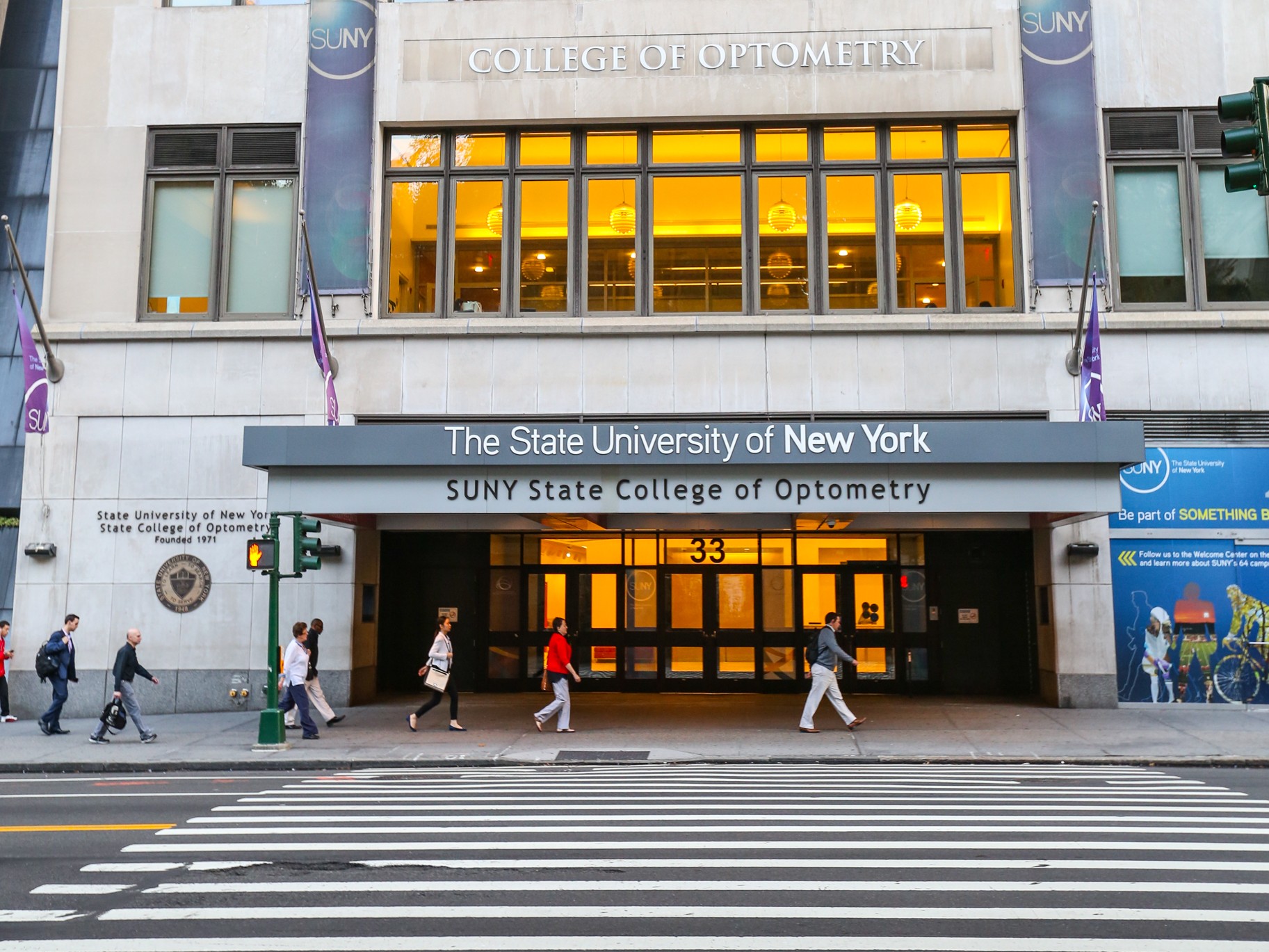
Students study on a dynamic campus in the heart of New York City on 42nd Street, just steps from iconic landmarks. Beginning Fall 2027, SUNY Optometry will be adding a program on the campus of SUNY Upstate Medical University in Syracuse*, to provide greater access to an exceptional optometric education for students and high-quality eye care for patients. No matter where students choose to study, they join an inclusive and student-centered community with the support and resources needed to thrive in and out of the classroom. SUNY Optometry’s exceptional learning outcomes and trusted excellence serve as the foundation for students to lead in the thriving field of optometry.
*pending final MSCHE approval
With more than 50 years of leading optometric education in New York City, SUNY College of Optometry offers:
Launching in 2027, the SUNY College of Optometry Upstate offers a unique learning experience with:


Microcredential programs offer advanced academic, clinical, and professional opportunities beyond the core Doctor of Optometry (OD) degree curriculum. Students dive deeper into specialized areas of optometric practice while gaining valuable, complementary skills. Completion is noted on the official transcript, highlighting the area of specialization.
Microcredential areas include:
*Currently only available at NYC campus

The Advanced Graduate Certificate in Optometry Business Management program is offered jointly by SUNY Optometry and SUNY Empire State University online. It’s a 6-course (3 credits per course), 18-credit program. Two courses are part of the OD program and four are offered online by SUNY Empire State University. Students may enter the program in the summer after their first year of the OD program. Credits from the program can be applied toward an MBA in Healthcare Leadership.

SUNY Optometry’s research fellowships, offered through the Graduate Center for Vision Research, give optometry students on the NYC campus hands-on experience in basic, translational, and clinical vision research. No prior research experience needed—just a drive to learn, think critically, and contribute to the future of patient care. Open to students who have completed their first or second year in an accredited optometry program.
Other NYC research opportunities include joint programs for OD/MS, OD/PHD, and working with experts through the Clinical Vision Research Center.
Average OD starting salary in NYS
scholarship and grants awarded annually
training site options for 4th year externships
patient encounters over 4 years
The SUNY Optometry curriculum integrates the basic biological and vision sciences that form the foundation of clinical practice combined with clinical exposure as early as year one. Under the supervision of our clinical faculty at the University Eye Center (UEC), students gain experience with a diverse patient base.
Highlights of What Students Experience:
SUNY College of Optometry alumni are represented in diverse areas of optometric practice, academia, industry, and other exciting careers. Career paths and positions include: