
National Recognition Highlights College’s Strength in Doctoral Research, Faculty Mentorship & Advancing the Science of Myopia
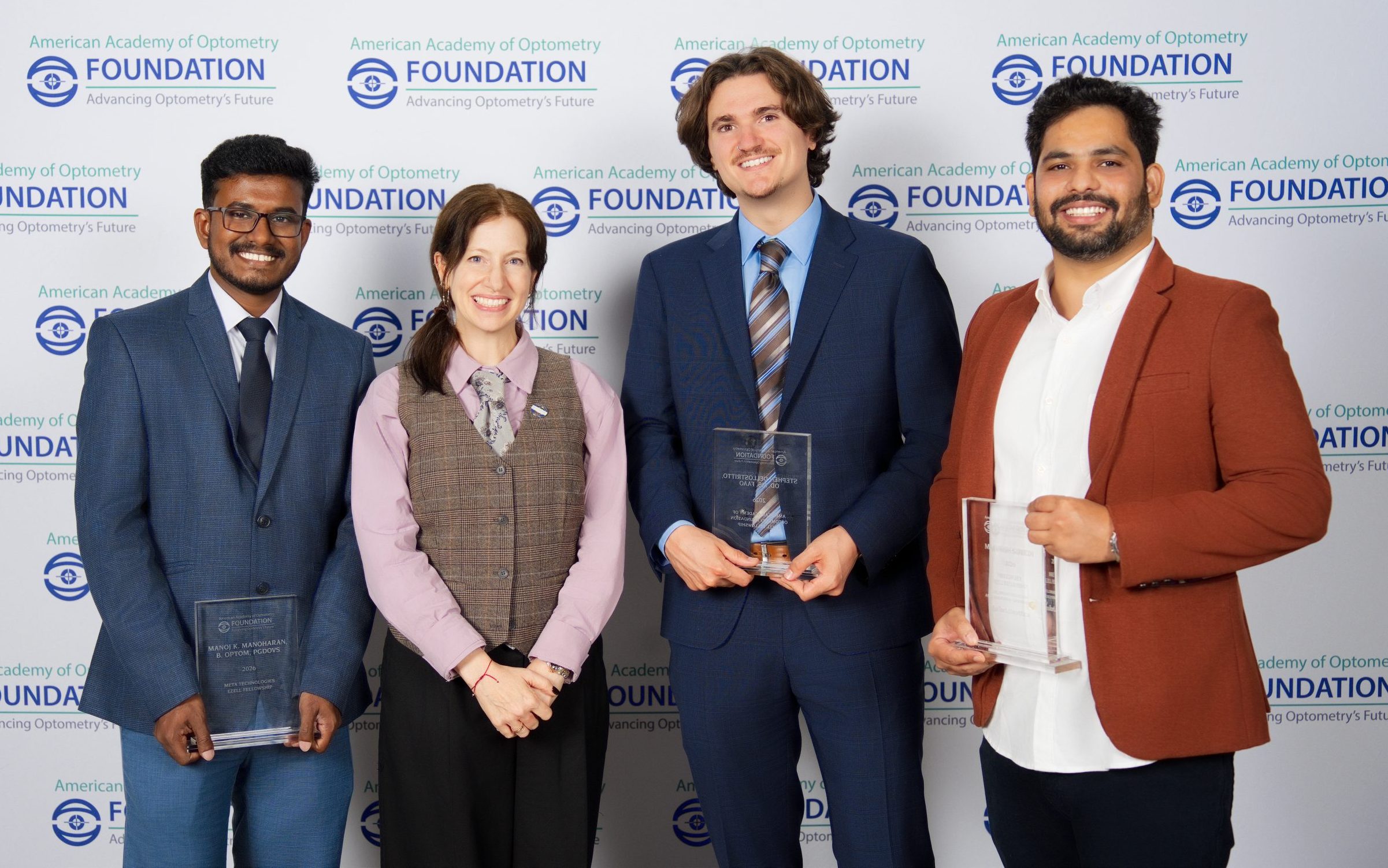
New York, NY — Three clinician scientists pursuing doctoral degrees at SUNY College of Optometry have been named 2026 William C. Ezell Fellows by the American Academy of Optometry Foundation (AAOF), one of the profession’s most prestigious honors for graduate students pursuing careers in vision research and education.
Manoj Manoharan, Manish Subedi and Stephen Dellostritto were selected for the highly competitive fellowships in recognition of their research accomplishments and potential to make significant contributions to vision science. All three are conducting research focused on myopia, or nearsightedness, exploring different aspects of how the eye processes visual information, develops and changes over time.
Established in 1949, the William C. Ezell Fellowship program supports graduate students pursuing advanced degrees in vision-related research. Each of the 2026 fellows receives $10,000 in support, including funding to attend major scientific conferences. The three SUNY Optometry recipients were recognized during Academy 2026 in Anaheim, California.
“Having three of our graduate program researchers recognized with Ezell Fellowships is an extraordinary achievement and a testament to the quality of the students and research taking place at SUNY Optometry,” said Dr. David Troilo, President of SUNY College of Optometry. “Manoj, Manish and Stephen are pursuing important scientific questions that could help us better understand how myopia develops and find new ways to prevent its onset and manage its progression. We congratulate each of them on this well-deserved recognition and look forward to the contributions they will continue to make to vision science and patient care.”
The recognition also highlights the strength of SUNY Optometry's doctoral research program, which brings together students with clinical backgrounds and experienced faculty researchers to investigate fundamental questions in vision science and translate discoveries into potential improvements in patient care.
“These fellowships recognize exceptional students who have demonstrated the drive, talent and commitment to make meaningful contributions to our field,” said Dr. Lisa Ostrin, Dean of Graduate Studies and Research at SUNY College of Optometry. “Their success also reflects the collaborative research environment we work to create at SUNY Optometry, where students have access to supportive faculty, strong mentorship and opportunities to pursue innovative research that connects scientific discovery with clinical care. That combination is essential to preparing the next generation of vision scientists.”
The 2026 SUNY Optometry Ezell Fellows are:
Stephen Dellostritto, OD, MS, FAAO, an Assistant Clinical Professor and doctoral researcher working under the mentorship of Dr. Jose-Manuel Alonso. His research investigates how different retinal pathways involved in processing light and dark visual information contribute to eye development and myopia. Using virtual reality-based visual field assessments, contrast testing and retinal imaging, Dellostritto is studying how changes in visual function correspond with structural changes in the nearsighted eye, with the goal of informing future approaches to myopia prevention and management.
Manoj K. Manoharan, B. Optom, PGDOVS, FAAO, a PhD student working under the mentorship of Dr. Lisa Ostrin. His research investigates how the body's internal biological clock, or circadian rhythms, affects visual function and the development of myopia. By examining how these biological mechanisms influence eye growth, Manoharan hopes to identify factors that contribute to nearsightedness and inform evidence-based approaches to its prevention and control.
Manish Subedi, B. Optom, a PhD student working under the mentorship of Dr. Alexandra Benavente-Perez. His research focuses on understanding how visual information influences eye growth, including how optical imperfections, the retina's processing of light and dark signals, and color perception may contribute to the development and progression of myopia. His work seeks to better understand how the eye responds to visual experiences and how those responses may influence nearsightedness.
The recipients' research reflects SUNY Optometry's broader commitment to advancing understanding of myopia, a growing public health concern affecting children and adults worldwide. Their projects examine different biological and visual mechanisms that may contribute to the condition, with the shared goal of advancing scientific knowledge that could eventually lead to better strategies for protecting vision.
SUNY Optometry offers graduate programs leading to MS and PhD degrees in vision science, providing opportunities for students to pursue advanced research alongside faculty working across basic, translational and clinical disciplines. The College's research environment supports collaboration between scientists and clinicians, helping prepare graduates for careers in academic research, industry and optometric education.
About SUNY Optometry
Founded in 1971 in New York City, the State University of New York College of Optometry is the only school of optometry in the state and a nationally recognized leader in optometric education, vision research and patient care. The College prepares the next generation of eye care professionals through its Doctor of Optometry program, residency programs and advanced graduate degrees in vision science, including MS and PhD programs. As an academic health center in optometry dedicated to advancing eye and vision care, SUNY Optometry conducts a robust portfolio of basic, translational and clinical research focused on improving diagnosis, treatment and understanding of visual disorders. Beginning in fall 2027, the Doctor of Optometry degree will be offered in both New York City and Syracuse, providing students the opportunity to choose where they live and practice.