
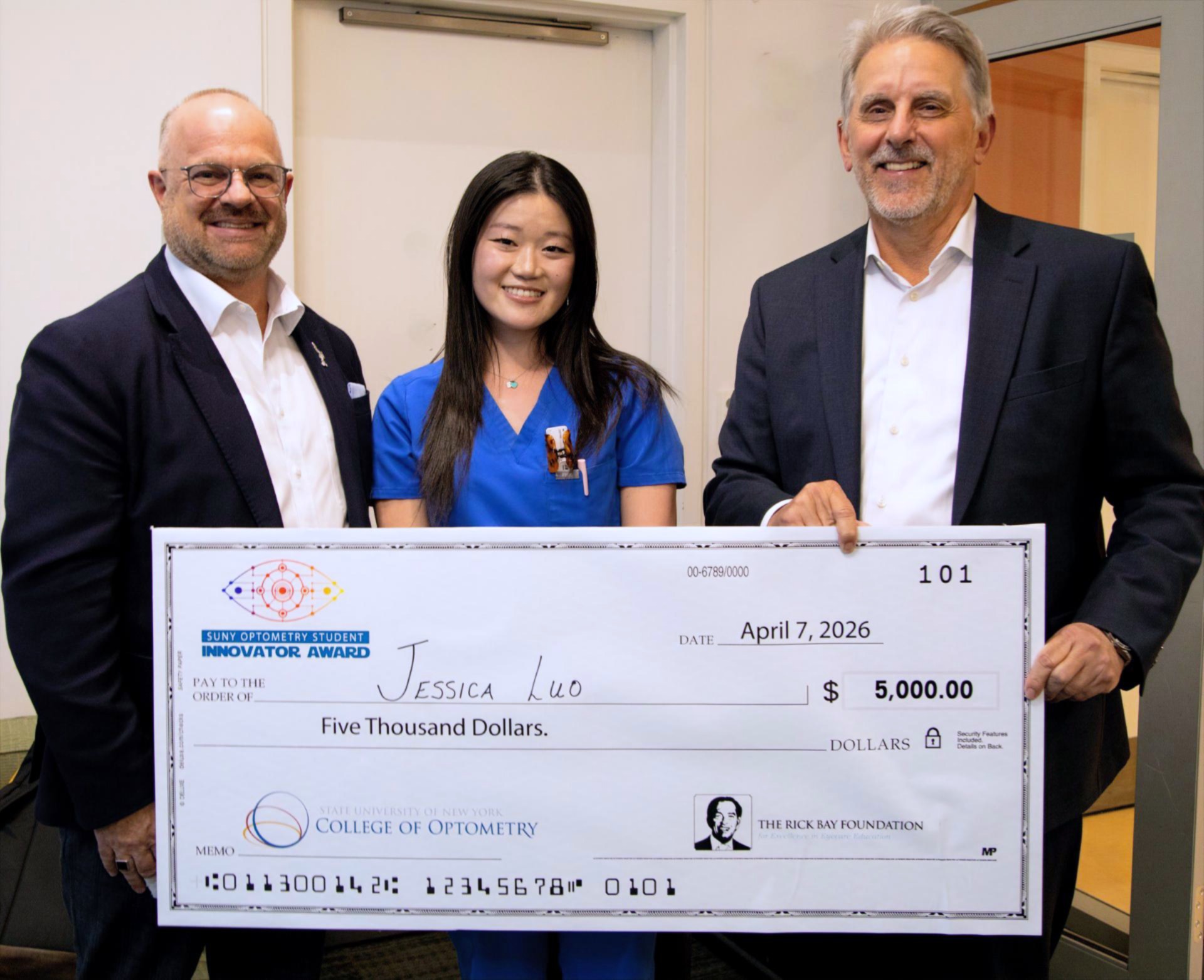
New York, NY — Third-year OD student, Jessica Luo, received the 2026 SUNY Optometry Student Innovator Award for her business plan Eye Q – a collaborative and adaptive learning platform to support and connect optometry students preparing for the NBEO exams. EssilorLuxottica provided an educational grant to the Rick Bay Foundation for Excellence in Eye Care Education general scholarship fund. A $5,000 scholarship was awarded to an original concept developed by a SUNY Optometry student that is impactful, viable, and feasible in today’s optometric landscape.
Inspired by her own experiences in studying for the grueling test that all optometry students must take, Luo is developing a study tool that enables students to use mock questions and receive AI generated feedback. Her extensive experience participating in undergraduate hackathons helped to inform Luo’s innovation, which she plans to officially launch later this spring.
“Research and innovation are what drives this profession forward,” said Dr. David Troilo, President of SUNY College of Optometry. “This is a wonderful opportunity to hear creative and powerful ideas that can enhance the way students learn, improve the quality of life for visually impaired patients, and transform the field of optometry.”
“Optometry needs forward-thinking innovators like the finalists who presented extremely well-thought out business pitches tonight,” said Aaron Goffinet, OD, Director of Professional Affairs-Universities at EssilorLuxottica. “Their creativity in marrying research, AI and technology to address real-world needs of patients and students is both impressive and inspiring.”
Each Fall, students are invited to submit abstracts related to innovations or improvements in clinical eyecare, research, practice management, optometric education, health care policy, community education, technology, social media and more. Submissions are reviewed by committee at the College and only 3-5 finalists are selected to develop their ideas further and present them before a judging panel.
On April 7, before an audience of faculty, students and staff, each finalist was given ten minutes to provide concise backgrounds on their respective plans with five minutes for Q&A from the judges. In addition to Luo’s winning presentation, Gabriella Reale discussed her app, Walk My Way, which integrates several tools to provide navigation inside buildings for the visually impaired, and David Wang shared Auto Tear, a wearable device offering dry eye relief.
The judging panel comprised of SUNY Optometry faculty Alexandra Benavente Perez, PhD, Research Professor; Marina Su, OD, FAAO, Vice President for Clinical Affairs and Executive Director of the University Eye Center; Dr. Michael Sullivan-Mee, OD, FAAO, AAO Dipl., Clinical Professor and Chair of Clinical Education; Melissa Trego, OD, PhD, Vice President and Dean for Academic Affairs. After the presentations were completed, the judges convened to pick a winner which they announced during a post-event reception.
About SUNY College of Optometry
Founded in 1971 and located in New York City, the State University of New York College of Optometry is a leader in education, research and patient care, offering the Doctor of Optometry degree as well as MS and PhD degrees in vision science. The College conducts a robust program of basic, translational and clinical research and has 65 affiliated clinical training sites as well as an on-site clinic, the University Eye Center. SUNY Optometry is regionally accredited by the Commission on Higher Education of the Middle States Association of Colleges and Secondary Schools; its four-year professional degree program and residency programs are accredited by the Accreditation Council on Optometric Education of the American Optometric Association. To learn more, visit www.sunyopt.edu.
###